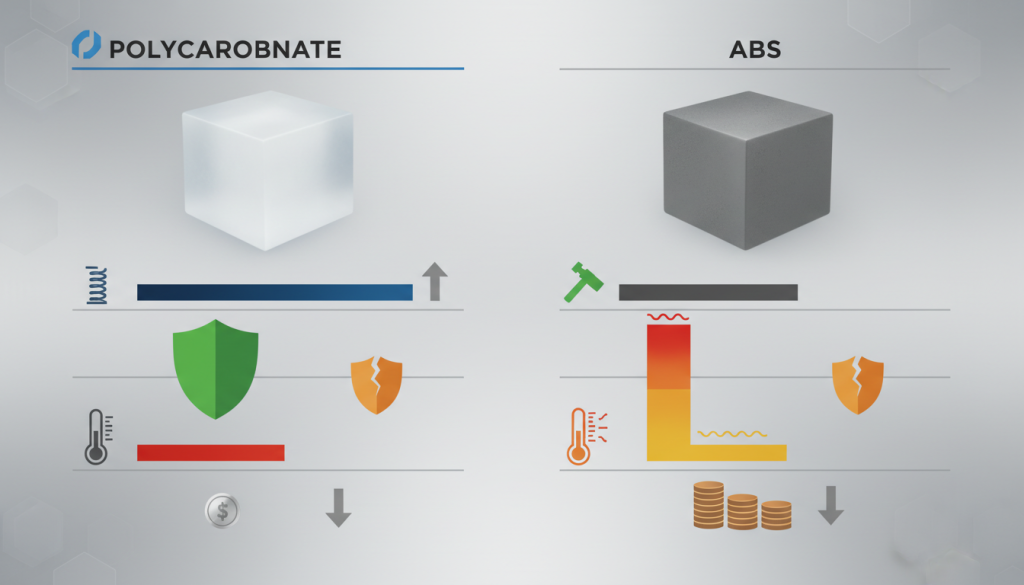
Polycarbonate offers extreme impact resistance and optical clarity, while ABS provides a cost-effective, rigid solution for opaque structural housings. You often face the challenge of selecting a material that balances performance with production budgets. Using the wrong plastic can lead to premature part failure or unnecessary cost overruns in your supply chain. Deciding between Polycarbonate vs. ABS ensures your engineering team meets mechanical specifications without sacrificing your bottom line.
Why is Polycarbonate vs. ABS a critical choice?
Choosing between these two materials determines whether your part will withstand high impact or offer better surface aesthetics at a lower price. Both resins are staples in industrial manufacturing but serve vastly different functional roles.
Here is the deal: Polycarbonate vs. ABS selection impacts everything from mold design to final assembly costs. You must evaluate the environment your product will inhabit before committing to a specific resin grade.
What are the chemical origins of Polycarbonate?
Polycarbonate is a thermoplastic polyester created through a reaction between bisphenol A and phosgene gas. It is known for non-crystalline, loosely packed polymer chains that allow light to pass through easily.
- Superior energy absorption due to molecular structure.
- Naturally transparent and optically clear.
- Highly flexible at room temperature for secondary forming.
How is ABS plastic uniquely formulated?
ABS is a terpolymer made by polymerizing acrylonitrile, butadiene, and styrene. By adjusting the ratios of these three monomers, manufacturers can tailor the material for higher toughness or better surface gloss.
- Acrylonitrile provides chemical resistance and heat stability.
- Butadiene contributes high impact strength and durability.
- Styrene offers a glossy finish and excellent processability.
Key Takeaway
Understanding the chemical makeup of these plastics allows you to predict how they will behave under mechanical stress. This foundational knowledge prevents over-engineering your components.
| Property | Polycarbonate (PC) | ABS | |
|---|---|---|---|
| Material Category | Thermoplastic Polyester | Terpolymer | |
| Natural State | Transparent | Opaque (Ivory) | |
| Impact Strength | Extremely High | Moderate to High |
Selecting the right chemical base ensures long-term part reliability in the field.
Which has better strength in Polycarbonate vs. ABS?
Polycarbonate significantly outperforms ABS in tensile strength and ultimate impact resistance. While both are tough, PC can handle nearly double the stress before failing in many high-load applications.
But wait, there is more: When evaluating Polycarbonate vs. ABS , you must consider how they react to sudden shocks. PC tends to flex where other plastics might shatter or crack under pressure.
Does PC offer higher tensile strength?
Yes, Polycarbonate typically offers a tensile strength range of 58 to 72 MPa. This makes it ideal for safety equipment and structural windows that must remain intact under extreme pressure.
- Resistant to fractures and stress cracking.
- Maintains structural integrity under heavy loads.
- Excellent elongation properties compared to brittle alternatives.
How do they perform in Plastic Injection Molding?
During Plastic Injection Molding , ABS is often preferred for complex shapes because it flows easier into thin walls. However, PC is required when the final part must endure high mechanical loads or heavy handling by end-users.
- ABS offers better dimensional stability for intricate internal ribs.
- PC requires higher clamping forces due to its higher viscosity.
- Both materials support insert molding for reinforced metal components.
Key Takeaway
Polycarbonate is the winner for pure mechanical strength, while ABS is the choice for rigid, complex geometries that do not require transparency. Your choice should depend on the specific load requirements of your assembly.
| Strength Metric | Polycarbonate (PC) | ABS | |
|---|---|---|---|
| Tensile Strength | 58–72 MPa | 31–50 MPa | |
| Impact (Izod Notched) | 600–900 J/m | 200–400 J/m | |
| Rockwell Hardness | R118–R125 | R68–R118 |
Mechanical data confirms that PC is the superior choice for high-stress industrial environments.
How does heat impact Polycarbonate vs. ABS parts?
Polycarbonate maintains its shape at much higher temperatures than ABS, with a heat deflection temperature reaching up to 138°C. ABS begins to soften much earlier, usually around 95°C to 100°C, which limits its use in high-heat environments.
It gets even better: Choosing the right thermal profile for your Polycarbonate vs. ABS parts prevents warping during transport or operation. High-heat environments, like automotive engine bays, strictly require the stability of PC.
Which material has a higher deflection?
Polycarbonate is the clear leader here, as it can withstand continuous exposure to heat without losing its mechanical properties. This stability is vital for lighting fixtures and electronics that generate significant internal heat.
- PC Heat Deflection Temperature (HDT): ~138°C.
- ABS Heat Deflection Temperature (HDT): ~97°C.
- PC retains its toughness even at sub-zero temperatures.
Does ABS warp more easily than Polycarbonate?
Yes, ABS is more prone to warping if the cooling cycle in the mold is not perfectly managed. While it is easier to process, its lower thermal resistance means it can deform under concentrated heat sources or direct sunlight.
- ABS is highly sensitive to rapid temperature fluctuations.
- PC requires specialized high-temperature molds to prevent internal stress.
- Proper DFM ensures both materials cool evenly to maintain tolerances.
Key Takeaway
Polycarbonate is necessary for any application involving heat, whereas ABS is sufficient for consumer goods used at room temperature. Identifying the operating temperature range is a prerequisite for material specification.
| Thermal Property | Polycarbonate (PC) | ABS | |
|---|---|---|---|
| Heat Deflection (0.45 MPa) | 138°C | 97°C | |
| Glass Transition (Tg) | 147°C | 105°C | |
| Max Service Temp | 120°C | 80°C |
Thermal stability is the primary differentiator when designing parts for electronics or automotive interiors.
Is clarity vital for your Polycarbonate vs. ABS part?
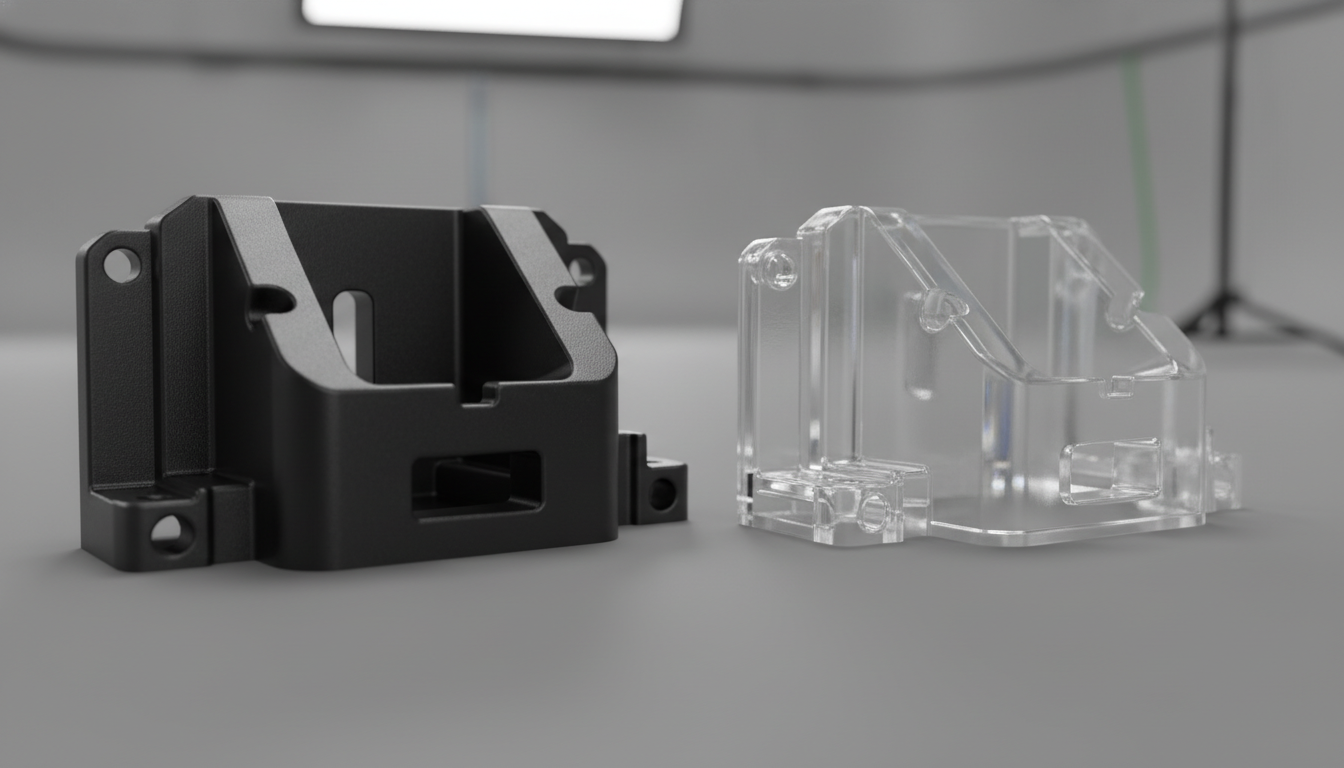
Polycarbonate is naturally transparent with light transmission comparable to glass, whereas ABS is naturally opaque and ivory-colored. If your project requires a window, lens, or clear cover, PC is the only viable choice among the two.
The best part? When choosing Polycarbonate vs. ABS , you can achieve different aesthetic goals. While PC offers transparency, ABS provides a broader range of vibrant colors and surface textures for consumer electronics.
Why is PC transparent while ABS is opaque?
The amorphous structure of Polycarbonate allows light to pass through the polymer chains with minimal scattering. ABS contains rubbery butadiene particles that scatter light, resulting in an opaque appearance that cannot be made clear.
- PC offers 89% to 91% light transmission.
- ABS is used for internal components where visibility is not required.
- PC can be tinted while maintaining its see-through properties.
Can ABS achieve high-gloss finishes?
Absolutely, ABS is prized for its ability to take on a “piano black” or high-gloss finish through the molding process. This makes it a favorite for toys, medical device housings, and high-end household appliances.
- Easily accepts various pigments for color matching.
- Supports matte, satin, or high-gloss surface textures.
- Allows for secondary processes like painting or metal plating.
Key Takeaway
Use Polycarbonate for visibility and impact protection, but choose ABS for opaque parts that require high-quality color and surface aesthetics. Aesthetics often drive the final decision in consumer-facing products.
| Aesthetic Metric | Polycarbonate (PC) | ABS | |
|---|---|---|---|
| Light Transmission | 90% | Opaque | |
| Refractive Index | 1.58 | N/A | |
| Standard Finish | Smooth/Clear | Glossy/Textured |
Visual clarity requirements often make the choice between these two materials instantaneous.
How does molding vary for Polycarbonate vs. ABS resins?
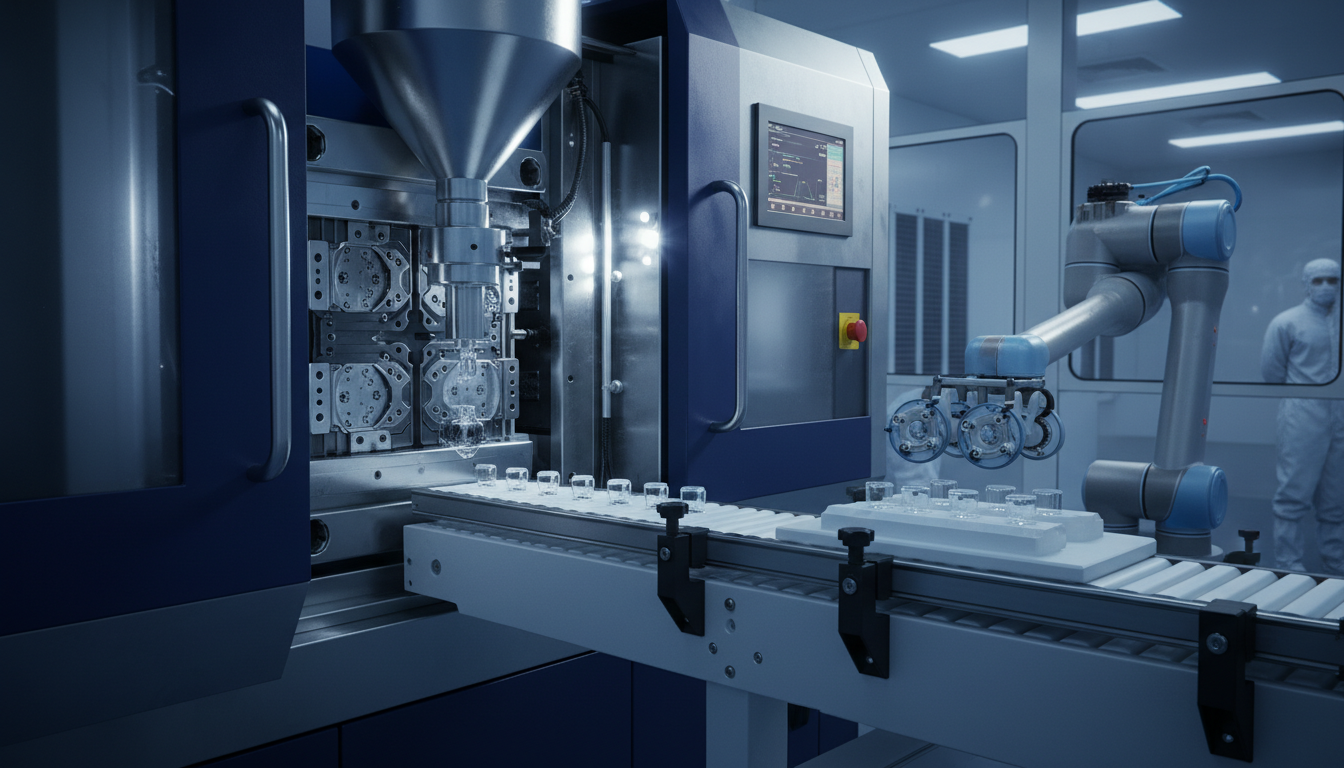
ABS generally flows more easily into complex Injection Molds , making it easier to manufacture parts with thin walls or deep ribs. Polycarbonate has a higher viscosity, requiring specialized machines and higher temperatures to achieve a successful fill.
You might be wondering: How does this affect your production timeline for Polycarbonate vs. ABS? ABS typically allows for faster cycle times, which can reduce your overall manufacturing costs on high-volume runs.
Which material flows better in precision molds?
ABS has a lower melt viscosity, which allows it to travel through long runners and thin gates without freezing prematurely. This makes it the preferred resin for large housings or parts with intricate internal details.
- ABS melt temperature: 200°C to 240°C.
- PC melt temperature: 280°C to 320°C.
- Lower pressure requirements for ABS reduce mold wear over time.
How do shrink rates impact mold design?
Polycarbonate and ABS have relatively similar shrink rates, but PC is slightly more predictable at 0.5% to 0.7%. ABS shrinkage can vary more depending on the grade and filler content, ranging from 0.4% to 0.9%.
- Consistent shrinkage is vital for tight-tolerance assemblies.
- PC is more sensitive to “gate blush” or surface defects if not gated properly.
- ABS handles wall thickness variations with fewer sink marks.
Key Takeaway
ABS is the more “forgiving” material during the injection molding process, leading to fewer defects and lower setup costs. However, PC is essential when the physical properties outweigh the difficulty of processing.
| Molding Parameter | Polycarbonate (PC) | ABS | |
|---|---|---|---|
| Melt Temperature | 280–320°C | 200–240°C | |
| Mold Temperature | 80–120°C | 40–80°C | |
| Shrinkage Rate | 0.5–0.7% | 0.4–0.9% |
Optimizing molding parameters ensures that both materials meet your dimensional specifications with minimal scrap.
Which is easier to mill in Polycarbonate vs. ABS?
ABS is generally easier to machine because it is less prone to melting or gumming up the cutting tools compared to PC. While both can be processed via CNC Machining Service , ABS produces a cleaner chip and a smoother natural finish.
Think about this: If you are prototyping a Polycarbonate vs. ABS component, machining allows you to test form and fit before investing in expensive tooling. ABS is the faster, more cost-effective choice for these early-stage iterations.
How do CNC tolerances vary between them?
Both materials can achieve tight tolerances of ±0.05mm, but ABS is slightly more dimensionally stable during the cutting process. Polycarbonate can build up internal stress during machining, which might lead to slight warping if not stress-relieved.
- ABS mills cleanly with standard carbide tooling.
- PC may require cooling to prevent the plastic from softening during high-speed cuts.
- Both support tapping and threading for mechanical fasteners.
Does PC or ABS produce better surface finishes?
ABS naturally leaves a matte finish that can be vapor polished to a high gloss quite easily. Polycarbonate can be polished to high clarity, but the process is more labor-intensive and requires specialized compounds to remove tool marks.
- ABS is ideal for painting and secondary finishing.
- PC machining is preferred for clear prototypes like light pipes.
- Tool wear is significantly lower when machining ABS.
Key Takeaway
ABS is the superior choice for CNC machining when transparency is not required, offering lower costs and faster turnaround. Polycarbonate is reserved for machined parts that must be clear or exceptionally strong.
| Machining Factor | Polycarbonate (PC) | ABS | |
|---|---|---|---|
| Machinability | Moderate | High | |
| Tool Wear Rate | Moderate | Low | |
| Post-Processing | Vapor/Manual Polishing | Painting/Vapor Polishing |
Selecting ABS for CNC prototypes can significantly reduce your development lead times and tooling wear.
How is UV resistance in Polycarbonate vs. ABS?
Neither material is naturally UV-stable, but ABS tends to yellow and become brittle much faster than Polycarbonate when exposed to sunlight. Without stabilizers, Polycarbonate will also lose its clarity and strength over several years of outdoor use.
Here is the kicker: For any outdoor application, the Polycarbonate vs. ABS debate is often settled by the availability of UV-resistant grades. You must specify these additives to ensure your product doesn’t fail after a single summer.
Can ABS withstand outdoor exposure?
Unmodified ABS is not recommended for outdoor use because the styrene component degrades quickly under ultraviolet radiation. This leads to chalking on the surface, loss of impact strength, and severe color shifting.
- ABS requires a cap layer or UV-resistant coating for outdoor products.
- Exposure to sunlight can cause “crazing” or small cracks in the plastic.
- Moisture absorption is higher in ABS, affecting long-term stability.
Do UV stabilizers help Polycarbonate?
Yes, UV-stabilized Polycarbonate is the industry standard for outdoor signs, skylights, and automotive headlights. These additives absorb the harmful radiation before it can break the molecular bonds of the polymer.
- Protects against yellowing and loss of light transmission.
- Maintains impact resistance even after years of exposure.
- Significantly lower moisture absorption (0.2%) than ABS (1.8%).
Key Takeaway
Polycarbonate is the more durable choice for outdoor environments, provided you select a UV-stabilized grade. ABS should generally be limited to indoor applications or protected with specialized coatings.
| Environmental Resistance | Polycarbonate (PC) | ABS | |
|---|---|---|---|
| UV Resistance | Good (with stabilizers) | Poor | |
| Moisture Absorption | 0.2% | 1.8% | |
| Chemical Resistance | Moderate (Alcohols/Acids) | Moderate (Oils/Salts) |
Environmental factors often dictate the material choice long before mechanical needs are considered.
Why utilize a blend for Polycarbonate vs. ABS?
Blending the two resins creates PC-ABS, a high-performance material that combines the strength of PC with the ease of processing found in ABS. This blend is the “gold standard” for the automotive and electronics industries where toughness and aesthetics must coexist.
Look no further: A Polycarbonate vs. ABS blend is likely the answer if you need high impact strength but want to avoid the high cost and molding difficulties of pure PC. It offers the best balance of properties for most mid-to-high-end applications.
Does PC-ABS offer the best of both?
Yes, PC-ABS exhibits high heat resistance and impact strength while flowing much better in the mold than pure Polycarbonate. This allows you to design thinner walls without worrying about part failure or difficult manufacturing cycles.
- Improved ductility compared to pure ABS.
- Higher heat resistance than standard ABS grades.
- Excellent surface finish and ease of coloring.
When should you specify a blend?
You should specify a PC-ABS blend for products like laptop housings, automotive dashboards, and telecommunications equipment. These items require a professional look, high durability, and the ability to be produced in high volumes with low defect rates.
- Ideal for parts requiring moderate heat and high impact.
- Reduces the cost of the material compared to 100% PC.
- Maintains dimensional stability better than pure ABS.
Key Takeaway
The PC-ABS blend is often the most practical choice for complex, high-performance housings. It eliminates the weaknesses of each individual resin while enhancing their collective strengths.
| Material | Strength | Heat Resistance | Flow Rate | |
|---|---|---|---|---|
| Polycarbonate | Highest | Highest | Low | |
| ABS | Moderate | Moderate | High | |
| PC-ABS Blend | High | High | Moderate |
Blended resins provide a versatile solution that meets the demanding requirements of modern engineering projects.
Which is more cost-effective: Polycarbonate vs. ABS?
ABS is the clear winner on price, typically costing 30% to 50% less than Polycarbonate per kilogram. If your part does not require the extreme heat or impact resistance of PC, switching to ABS can save your project thousands of dollars.
Let’s break it down: The total cost of Polycarbonate vs. ABS includes not just the raw resin, but also the cycle times and mold maintenance. ABS is generally cheaper to buy and faster to process, making it the superior economic choice.
Is the PC price premium justified?
The higher cost of Polycarbonate is only justified if your part must be transparent or survive extreme mechanical and thermal conditions. For many internal brackets or simple enclosures, the extra performance of PC is an unnecessary expense.
- Standard PC sheet: ~$31/kg.
- Standard ABS pellets: ~0.90–2.00/kg.
- PC prices fluctuate more based on chemical feedstock costs.
How does volume affect ABS pricing?
In high-volume production, the faster cycle times of ABS lead to significant savings in machine time and labor. Because ABS cools more quickly and flows easier, you can often produce more parts per hour than you could with Polycarbonate.
- Lower energy consumption due to lower melt temperatures.
- Reduced wear and tear on injection molds and CNC tools.
- Higher yield rates due to fewer molding defects.
Key Takeaway
ABS is the most budget-friendly choice for high-volume manufacturing of opaque parts. Use Polycarbonate only when the specific mechanical or optical properties are mandatory for part function.
| Economic Metric | Polycarbonate (PC) | ABS | |
|---|---|---|---|
| Relative Cost Index | 1.5 | 1.0 | |
| Production Speed | Moderate | High | |
| Material Waste Cost | High | Low |
Economic efficiency in B2B manufacturing often comes down to selecting the least expensive material that still meets all performance specs.
What is the final Polycarbonate vs. ABS choice?
The final choice depends on your specific application: choose Polycarbonate for safety and transparency, and ABS for cost-effective housings. If you need a balance of both, a Polycarbonate vs. ABS blend is your best path forward for high-performance engineering.
What does this mean for you? At CN Precision, we help you navigate these complex material decisions through our expert DFM analysis and IATF 16949 certified production processes. Whether you are building automotive safety parts or consumer electronics, we ensure the material matches the mission.
Which material fits automotive safety parts?
Polycarbonate is the standard for safety-critical parts like airbag covers and lighting lenses because it will not shatter into sharp fragments. Its high energy absorption protects passengers during an impact, unlike more brittle plastics.
- PC is used for structural interior components.
- ABS is preferred for non-structural trim and console parts.
- PC-ABS blends are the industry standard for dashboards.
Is ABS better for medical enclosures?
ABS is frequently used for medical device housings because it is rigid, easy to clean, and handles sterilization chemicals well. It provides a professional, high-gloss finish that instills confidence in the end-user while remaining cost-effective for large-scale production.
- Supports biocompatible grades for skin contact.
- Maintains appearance after repeated cleaning.
- Easy to modify with antimicrobial additives.
Key Takeaway
Your project requirements for strength, heat, and budget will ultimately dictate the winner. Always consult with a manufacturing partner early in the design phase to avoid costly material mistakes.
| Selection Factor | Choose Polycarbonate | Choose ABS | |
|---|---|---|---|
| Primary Need | Transparency/Impact | Cost/Aesthetics | |
| Environment | High Heat/Outdoor | Room Temp/Indoor | |
| Production | Structural/Safety | Housing/Consumer |
The right material selection is the foundation of a successful, cost-effective manufacturing strategy.
Selecting between Polycarbonate and ABS is more than a technicality—it is a strategic decision that affects your product’s durability, appearance, and profitability. We have explored how these materials differ in strength, thermal stability, and molding behavior to help you make an informed choice. At CN Precision, our vision is to empower global innovators with high-precision manufacturing that bridges the gap between design and reality. Whether you need advanced 2K molding or precise CNC machining, our team is ready to optimize your production. To start your project with a free DFM review, contact us today .
Frequently Asked Questions
Can I use ABS for transparent parts?No, ABS is naturally opaque and cannot be made clear. If you require transparency but want a cheaper alternative to Polycarbonate, you might consider Acrylic (PMMA), though it is much more brittle and lacks the impact strength of PC.
What is the best material for outdoor electronics?It depends, but UV-stabilized Polycarbonate is generally the best choice due to its higher resistance to sunlight and moisture. ABS will yellow and become brittle very quickly unless it is protected by a specialized UV-resistant cap layer or coating.
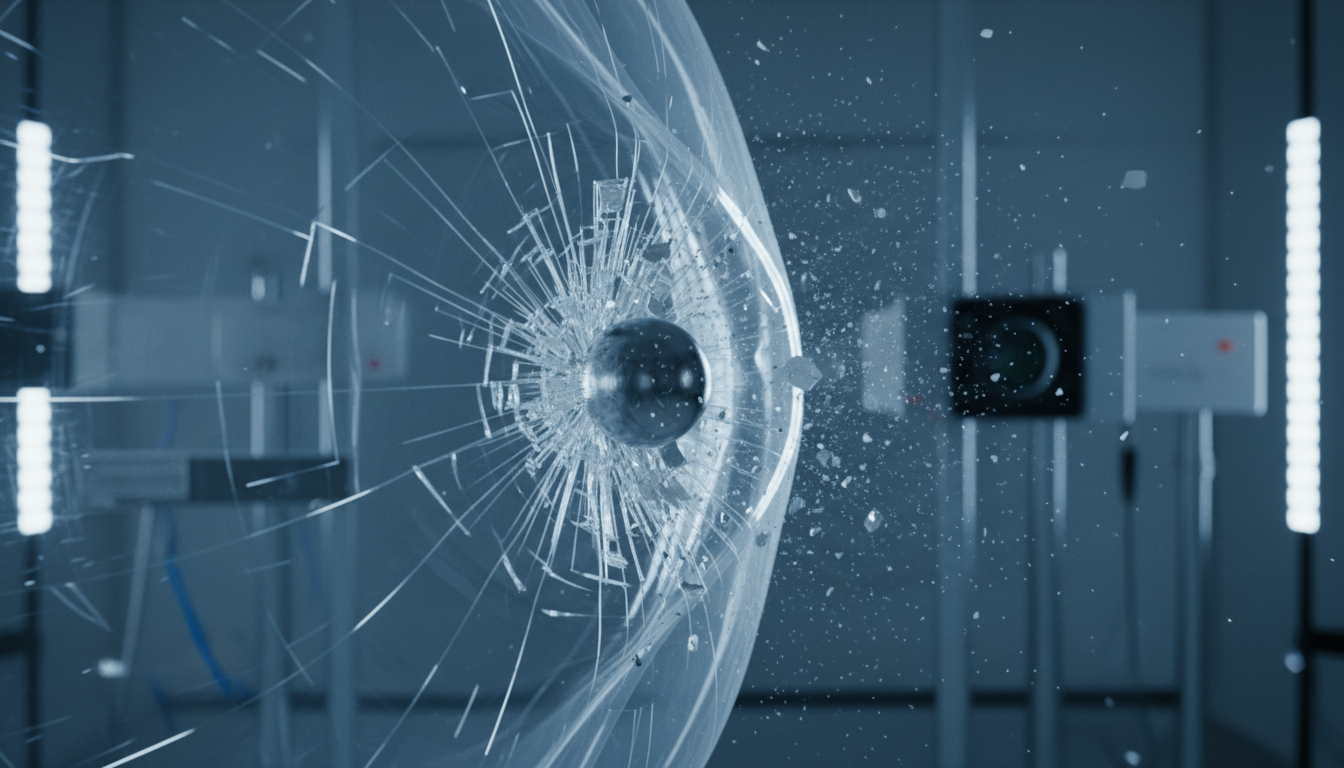
Is Polycarbonate stronger than glass?Yes, Polycarbonate is approximately 250 times stronger than glass while being significantly lighter. It is the preferred material for safety windows, riot shields, and eyewear because it absorbs impact energy without shattering like traditional glass.
Can I mix Polycarbonate and ABS in my own facility?No, it is highly recommended to buy a pre-formulated PC-ABS blend from a resin supplier. Blending them manually without specialized extrusion equipment can lead to poor material consistency, internal stress, and part failure during molding.
What is the best material for 3D printed prototypes?ABS is often the better choice for 3D printing prototypes because it is easier to extrude and requires less heat. While Polycarbonate can be printed, it often requires industrial-grade high-temperature printers to prevent warping and ensure proper layer adhesion.