
Successful plastic material selection requires a rigorous quantitative analysis of your part’s mechanical loads, thermal environment, and chemical exposure risks. Many engineers struggle to navigate more than 90,000 commercial resin options, often relying on guesswork that leads to catastrophic field failures or expensive mold re-tooling. This guide provides the structured framework you need to transform material choosing from a gamble into a precise engineering decision that ensures product durability.
Why is plastic material selection critical for success?
Choosing the right resin is the primary foundation for achieving both structural integrity and manufacturing cost-efficiency in your project. The plastic material selection process dictates everything from the physical tool design to the total cycle time required for production. Without a proper early-stage analysis, you risk creating parts that suffer from structural fatigue or aesthetic defects like sink marks and voids.
Does material choice impact your bottom line?
Resin costs vary significantly between cheap commodity plastics and high-performance specialty grades. However, focusing solely on the price per pound is a trap you must avoid. A cheaper material often requires longer cooling times in the mold or results in higher scrap rates during mass production.
How does selection affect end-user safety?
Look: In safety-critical sectors like automotive and medical device manufacturing, a material failure can have life-threatening consequences. You must ensure the chosen polymer maintains its molecular integrity under varied loads and environmental stressors.
- Prevents structural fatigue under load
- Ensures compliance with safety standards
- Reduces long-term liability risks
| Factor | Impact Level | Primary Concern | |
|---|---|---|---|
| Production Cost | High | Cycle time and scrap rates | |
| Part Safety | Critical | Structural failure risks | |
| Aesthetic Quality | Medium | Surface finish consistency |
Balancing these three factors during the initial design phase prevents expensive downstream re-engineering.
Key Takeaway: Early-stage material analysis is the only way to optimize the total cost of ownership while ensuring your product survives its intended lifecycle without failure.
How do you read a material data sheet effectively?
The standard material data sheet serves as your primary source of quantitative evidence for comparing different resin candidates. During plastic material selection , you must interpret these metrics as baseline values measured under controlled, room-temperature conditions. While useful for initial filtering, these numbers rarely reflect how a part will actually perform in a complex, real-world operating environment.
Interpreting room temperature metrics
Data sheets typically list tensile strength, flexural modulus, and impact resistance measured at exactly 23°C. You should treat these values as a starting point rather than a guarantee of performance at higher temperatures. Engineers use these snapshots to determine if a material belongs in the right “ballpark” for their specific application requirements.
Finding the gaps in standard data
The truth is, standard data sheets often omit the complex behavior of polymers under sustained stress or chemical contact. You may need to request supplemental design manuals or application notes from the resin supplier to fill these information gaps.
- Room temperature values are only a baseline
- Long-term behavior is rarely on the front page
- Comparison is only valid within the same family
| Metric | Typical Unit | Significance | |
|---|---|---|---|
| Tensile Strength | MPa / psi | Max load before yielding | |
| Flexural Modulus | GPa / psi | Overall material stiffness | |
| Notched Izod | J/m | Resistance to impact |
Standard metrics provide a filtered view of material potential but require context to be useful.
Key Takeaway: You must look beyond the “best-case scenario” numbers on a data sheet to understand how environmental factors will degrade those properties over time.
What role does temperature play in material choice?
Temperature is the most influential factor in determining how a polymer behaves once it leaves the factory floor. In your plastic material selection workflow, you must identify the maximum short-term and long-term thermal thresholds your part will encounter. Even a brief excursion above a material’s thermal limit can cause permanent deformation or a total loss of mechanical strength.
Heat Deflection vs. Vicat Softening
Heat Deflection Temperature (HDT) measures when a polymer deforms under a specific load, serving as a gauge for short-term heat resistance. The Vicat softening point represents the temperature where the material actually begins to lose its solid structural integrity.
- HDT is for loaded applications
- Vicat is for structural softening limits
- Both define the upper performance envelope
The glass transition threshold
Here is the deal: Amorphous polymers like Polycarbonate do not have a sharp melting point but instead experience a glass transition. At this specific temperature, the material shifts from a hard, glassy state to a rubbery, flexible state that cannot support structural loads.
- Amorphous resins lose strength gradually
- Semi-crystalline resins stay stiff until melting
- Operating temp must stay below transition
| Material Type | Example Resin | Typical HDT (0.45 MPa) | |
|---|---|---|---|
| Amorphous | Polycarbonate (PC) | 135°C | |
| Semi-crystalline | Polypropylene (PP) | 100°C | |
| Engineering | Nylon 6/6 (30% GF) | 250°C |
Thermal properties define the absolute physical boundaries within which your part can safely operate.
Key Takeaway: Always select a material with a thermal ceiling significantly higher than your maximum expected operating temperature to account for safety factors.
Which mechanical properties define part performance?
Mechanical requirements dictate the core geometry and wall thickness requirements of your injection molds . Effective plastic material selection requires you to analyze whether the stresses on your part will be constant, periodic, or sudden. This data determines if a resin is “tough” enough to survive impacts or “stiff” enough to resist bending under load.
Yield strength and ultimate tensile limits
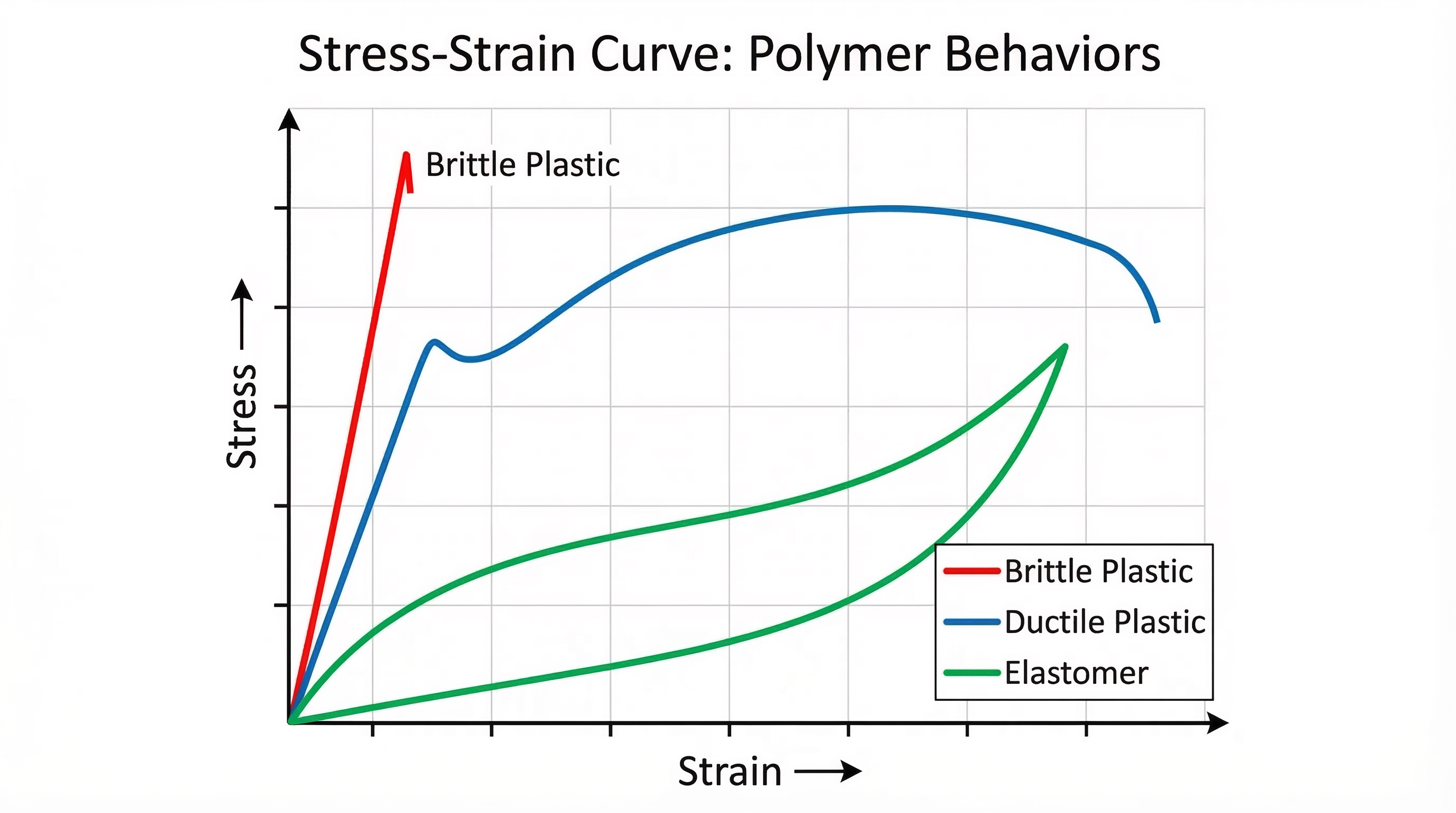
Yield strength is the most critical point because it represents where a material permanently deforms and fails to return to its original shape. For most engineered parts, the working stress must remain well below this yield point to ensure long-term functionality.
Understanding the modulus of elasticity
The modulus of elasticity is essentially a measure of how much a material will stretch or bend when a force is applied. You need to keep in mind that this stiffness can decline rapidly as temperatures rise or as loads are applied for extended periods.
- High modulus = high stiffness (e.g., PBT)
- Low modulus = high flexibility (e.g., PE)
- Modulus changes with strain rate
| Property | Brittle Plastic | Ductile Plastic | Elastomer | |
|---|---|---|---|---|
| Yield Point | High/Immediate | Moderate | Low/Undefined | |
| Elongation | Very Low | High | Extremely High | |
| Stiffness | Very High | Moderate | Low |
Mechanical selection focuses on keeping application stresses safely below the material’s yield and creep limits.
Key Takeaway: You must match the stiffness of your resin to the functional needs of the part while ensuring the material can absorb expected impact energy.
Why does chemical exposure cause plastic failure?
Environmental Stress Cracking (ESC) is widely recognized as the leading cause of plastic part failure in the field today. During plastic material selection , you must account for every chemical agent—including cleaners, oils, and vapors—that might touch your part. ESC occurs when a part is under mechanical stress while simultaneously being exposed to a specific chemical that weakens its molecular bonds.
The silent threat of stress cracking
Common substances that seem harmless, such as certain household detergents or industrial lubricants, can act as potent stress-cracking agents. Some polymers, like Polycarbonate, are highly susceptible to hydrocarbons and organic solvents which can cause brittle failure at very low stress levels.
- Stress + Chemical = Catastrophic Crack
- Failure often happens weeks after exposure
- Amorphous resins are more sensitive
Verifying chemical compatibility
The bottom line is that you cannot rely on mechanical strength alone if your part will be used in a harsh environment. You must consult compatibility charts to ensure your chosen resin family can withstand the specific chemicals present in its operating environment.
- Polyolefins offer great overall resistance
- Polyamides resist oils but fear strong acids
- Always test prototypes in the actual fluid
| Resin Family | Chemical Resistance | Common Threats | |
|---|---|---|---|
| Polyolefins (PP/PE) | Excellent | Strong Oxidizers | |
| Polyamides (Nylon) | Good | Strong Acids, Humidity | |
| Polycarbonates (PC) | Poor | Solvents, Industrial Oils |
Chemical compatibility must be verified alongside mechanical stress to prevent premature brittle failure in the field.
Key Takeaway: Environmental stress cracking can destroy even the strongest parts if you fail to account for the chemical “cockpit” of the application.
How do aging and RTI impact long-term durability?
Long-term durability is often measured by how well a polymer resists oxidative aging over many years of service. For effective plastic material selection , the Relative Thermal Index (RTI) is a much more reliable metric than simple heat deflection temperatures. This value helps you predict the service life of electrical components or under-hood automotive parts that face continuous heat.
The importance of RTI values
RTI represents the maximum temperature at which a material can be used while maintaining 50% of its original properties for 100,000 hours. You will find that this value is typically much lower than the short-term melting point or HDT listed on the data sheet.
Predicting degradation over time
Look: The rate of polymer degradation generally doubles with every 10°C increase in temperature above its stability limit. If your application involves continuous heat exposure for several years, selecting a material based on its RTI is the only way to ensure reliability.
- RTI 140°C means 11 years of life at that temp
- Higher heat significantly shortens life
- Critical for UL-rated electrical parts
| Resin | Short-term (HDT) | Long-term (RTI) | |
|---|---|---|---|
| ABS | 90°C | 60°C | |
| PBT (30% Glass) | 210°C | 140°C | |
| PEEK | 300°C | 240°C |
RTI is the most reliable metric for predicting long-term material survival in continuous heat applications.
Key Takeaway: Never confuse short-term heat resistance (HDT) with long-term thermal stability (RTI) when designing products meant to last for years.
Is the melt flow rate important for manufacturing?
While mechanical properties define how a part performs, the Melt Flow Rate (MFR) determines how easily that part can be manufactured. During plastic material selection , MFR serves as a proxy for the material’s molecular weight and its ability to fill complex mold geometries. Choosing the right MFR is a constant balance between the physical toughness of the part and the ease of the molding process.
MFR and molecular weight relationship
Lower MFR values indicate a higher molecular weight, which generally translates to superior impact resistance and fatigue life. Conversely, high MFR materials flow like water into thin walls but often sacrifice a degree of mechanical toughness to achieve that flowability.
- Low MFR = High Strength / Hard to Mold
- High MFR = Moderate Strength / Easy to Mold
- Impact resistance drops as MFR increases
Balancing flow and part strength
Here is the deal: If you are designing a part with very thin walls or intricate internal details, you may be forced to choose a higher MFR resin. However, for structural components that must survive drops or heavy loads, a lower MFR material is almost always the better engineering choice.
- MFR varies by testing temperature
- Only compare MFR within the same resin family
- High MFR reduces injection pressure needs
| MFR Level | Flow Characteristic | Best Application | |
|---|---|---|---|
| Low (< 5) | Viscous / Slow | Structural gears, thick walls | |
| Medium (10-20) | Standard | General housings, electronics | |
| High (> 30) | Fluid / Fast | Thin-walled connectors, micro-parts |
MFR helps balance manufacturing feasibility with the physical toughness required for the final application.
Key Takeaway: Select the lowest possible melt flow rate that can still reliably fill your mold to maximize the mechanical properties of your finished part.
When should you upgrade to high-performance resins?
Standard plastics like ABS or Polypropylene cover most consumer applications, but extreme environments demand specialty plastic material selection . High-performance polymers offer exceptional stability at temperatures exceeding 200°C and resistance to chemicals that would dissolve standard resins. While these materials carry a higher price tag, they are often the only viable solution for aerospace, medical, or under-hood automotive systems.
High-performance PEEK and Ultem
PEEK and PEI (Ultem) are considered the gold standards for extreme engineering, offering strength comparable to some metals. These resins are highly resistant to radiation, steam sterilization, and almost all organic solvents, making them ideal for surgical instruments and engine components.

Multi-material and 2K molding solutions
Sometimes, a single material cannot meet every requirement, which is where 2K or overmolding comes into play. This technology allows you to pair a rigid structural core with a soft-touch grip or an integrated rubber seal in a single manufacturing step.
- Combines different properties (Hard/Soft)
- Eliminates secondary assembly costs
- Improves ergonomics and sealing
- Look: It creates a permanent chemical bond
| Specialty Resin | Primary Benefit | Common Use | |
|---|---|---|---|
| PEEK | Extreme Heat/Chemicals | Piston parts, medical implants | |
| PPSU | High Sterilization Life | Medical trays, hot water fittings | |
| LCP | Incredible Flow/Thin Walls | Micro-connectors, PCBs |
Specialty resins and multi-material molding solve complex engineering challenges that commodity plastics cannot handle.
Key Takeaway: Use specialty resins when your environment exceeds the limits of standard engineering plastics, as the performance gain usually justifies the higher cost.
Why do industry certifications matter for selection?
In highly regulated markets, your plastic material selection is often restricted by specific safety and quality certifications. A material might have the perfect mechanical profile but fail to meet the flame retardancy or biocompatibility standards required for your industry. Partnering with a manufacturer that understands these compliance layers is vital for a successful product launch.
Automotive IATF 16949 standards
Automotive projects require strict material traceability and quality management systems to ensure part consistency across millions of units. Selecting resins that are already approved by major OEMs can significantly accelerate your validation process and reduce testing costs.
- Ensures batch-to-batch consistency
- Minimizes risk of production defects
- Required for Tier 1 and Tier 2 suppliers
Medical and electrical compliance
The bottom line is: Materials for medical devices must pass USP Class VI or ISO 10993 testing to ensure they are safe for human contact. Similarly, electrical housings often require UL 94 flame ratings to prevent fire hazards in consumer electronics.
- Medical: Biocompatibility is key
- Electrical: V-0 flame ratings often required
- Food Grade: FDA compliance is mandatory
| Industry | Key Certification | Primary Material Requirement | |
|---|---|---|---|
| Automotive | IATF 16949 | Traceability & Stability | |
| Medical | ISO 13485 | Biocompatibility / Sterility | |
| Electrical | UL 94 | Flame Retardancy |
Industry certifications ensure material consistency and compliance with global safety and quality standards.
Key Takeaway: Always verify that your chosen resin carries the necessary certifications for your target market before committing to final tooling.
What are the common rules of thumb for engineers?
When you need to make a fast decision without performing a full computational analysis, there are several “rules of thumb” for plastic material selection . These general guidelines help you choose a reliable baseline resin for prototypes or benign applications. While not a substitute for deep engineering, these choices work for a vast majority of general-purpose injection molded parts.
Starting with the “Big Three” resins
Most projects can start by evaluating ABS, Polypropylene, or Polycarbonate as their primary candidates. ABS is the ultimate all-rounder, offering a great balance of strength, cost, and appearance for housings and handheld devices.
- Start with ABS for general housings
- Use Polypropylene for living hinges or low cost
- Choose Polycarbonate for high impact or clarity
When to trust your gut vs. the math
Look: If your application lives at room temperature and doesn’t carry heavy loads, you can often pick a material based on visual and tactile needs. However, as soon as life safety or high temperatures are involved, you must throw out the rules of thumb and do the actual engineering math.
- Don’t guess for safety-critical parts
- Prototype in the actual production resin
- Watch out for high-shrink materials like PP
| Design Goal | Best “Rule of Thumb” Resin | Why? | |
|---|---|---|---|
| General Purpose | ABS | Good balance of all properties | |
| Lowest Cost | Polypropylene (PP) | Cheap and easy to process | |
| High Toughness | Polycarbonate (PC) | Best impact resistance |
Following established rules of thumb can simplify initial material screening for non-critical applications.
Key Takeaway: Use ABS as your default “safe” choice for general parts, but always validate your selection through physical testing before mass production.
Choosing the right polymer shouldn’t be a guessing game that threatens your product’s success. By following a structured selection framework—analyzing thermal limits, mechanical loads, and chemical risks—you can eliminate the most common causes of part failure before they ever happen. At CN Precision, we specialize in helping global brands navigate these complex decisions with IATF 16949 certified quality and deep engineering support. Whether you need high-precision automotive components or multi-material medical devices, our team is here to optimize your manufacturing journey. Please contact us today to schedule a technical consultation and receive a free DFM review for your next project.
FAQ
Can I use the same mold for two different materials?
Generally no, because every resin has a unique shrink rate that the mold is specifically designed to accommodate. If you swap a high-shrink material like Polypropylene into a mold built for low-shrink ABS, the final parts will likely be out of tolerance and dimensionally inaccurate.
What’s the best plastic for outdoor UV exposure?
ASA (Acrylonitrile Styrene Acrylate) is usually the best choice because it is chemically similar to ABS but features superior resistance to UV radiation and weathering. While standard ABS will turn yellow and become brittle in the sun, ASA maintains its color and mechanical strength for years of outdoor use.
How do I know if my part needs a glass-filled resin?
You should consider glass-filled resins if your part requires significantly higher stiffness, improved dimensional stability, or better heat resistance than the base polymer provides. Glass fibers reduce the overall thermal expansion and increase the flexural modulus, making the part much more rigid under load.
Can I overmold a soft material onto any rigid plastic?
No, successful overmolding requires chemical compatibility between the two materials so they can form a permanent bond at the molecular level. For example, some TPEs bond perfectly to Polypropylene but will peel right off of Polycarbonate unless a specific bonding grade is selected.